High Resolution X-Ray Photo Electron Spectroscopy

The XPS Technique

X-ray photoelectron spectroscopy (XPS) is a powerful technique widely used for the surface analysis of materials. At low energy resolution it provides qualitative and quantitative information on the elements present. At high energy resolution it gives information on the chemical state and bonding of those elements. Further chemical information is available from the XPS valence band. Variation of electron take-off angle or sputter depth profiling can provide information on the vertical heterogeneity of samples, and imaging/microanalysis techniques allow determination of lateral homogeneity with resolutions of <50µm. Samples can be subjected to various treatments within the spectrometer vacuum system prior to analysis, eg. heating, cooling, scraping, cleaving, sputter cleaning, etc. XPS is commonly used for the surface analysis of polymers, coatings, catalysts, composites, fibres, ceramics, pharmaceutical/medical materials and materials of biological origin.

In the XPS technique, X-ray photons of a well defined energy (eg. Al K(alpha) radiation at 1486.7eV) impact the sample and eject photoelectrons from the atomic core level and valence levels. The photoelectrons travel only a relatively short distance (~3nm) in solids before impacting the lattice and suffering an inelastic collision. This makes the technique inherently surface sensitive. The ejected photoelectrons are energy analysed (usually by a combination of an electrostatic lens and an electrostatic hemispherical analyser) and strike an electron detector. A computer based data system scans the electron energy and accumulates counts of the detected electrons, hence generating the photoelectron spectrum. The data system is also used for subsequent manipulation of spectra, eg. elemental identification, quantification, curve fitting and plotting.

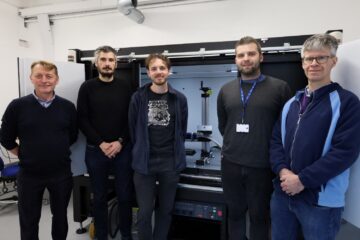
The Scienta ESCA300 Spectrometer at NCESS
Example Results obtained with the Scienta ESCA300

div_sc.gif (1744 bytes)

Contacts
Mr Bob Bilsborrow    Dr Danny S-L Law

div_sc.gif (1744 bytes)

Back to NCESS Index